
What is CTET Exam?
The Central Teacher Eligibility Test (CTET) is a national-level teacher eligibility examination conducted by the Central Board of Secondary Education (CBSE). The examination is designed to assess the teaching aptitude, subject knowledge and professional understanding of candidates who wish to become teachers in Central Government schools and various educational institutions across India.
CTET is one of the most important examinations for aspiring teachers because it serves as a minimum eligibility requirement for recruitment in Kendriya Vidyalayas, Navodaya Vidyalayas, Central Government Schools and many state government and private schools that recognize CTET qualifications.
Every year lakhs of candidates appear for CTET with the goal of building a stable teaching career. The examination not only evaluates academic knowledge but also tests a candidate’s understanding of child development, pedagogy and effective teaching methods.
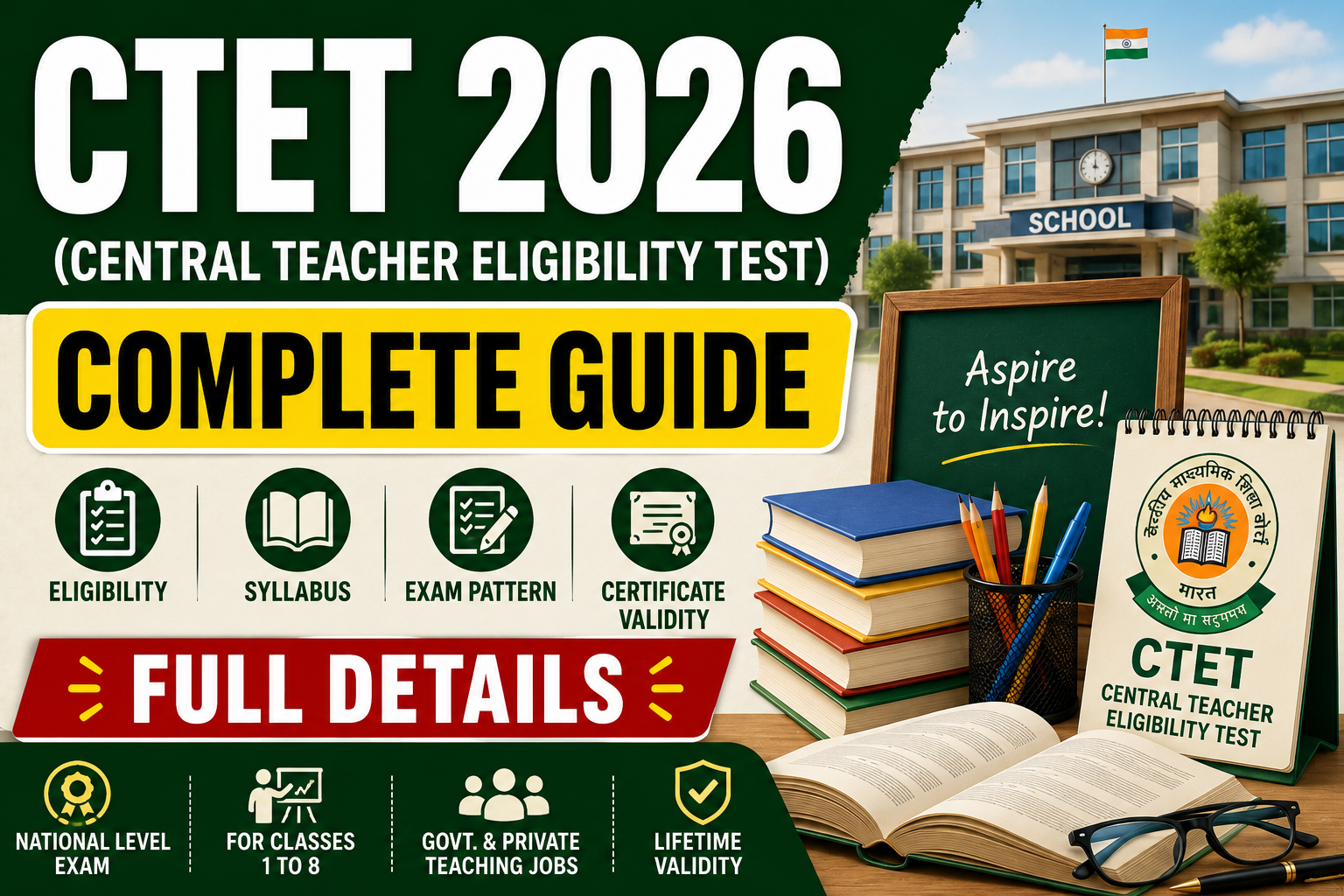
CTET Full Form
CTET stands for Central Teacher Eligibility Test. It is conducted by the Central Board of Secondary Education (CBSE) under the guidelines of the Ministry of Education, Government of India.
The primary objective of CTET is to ensure that teachers entering the education system possess the necessary skills, knowledge and teaching aptitude required for quality classroom instruction.
Why is CTET Important?
- National-Level Teacher Eligibility Certificate.
- Required for many Central Government teaching jobs.
- Accepted by numerous state governments.
- Recognized by many private schools.
- Improves teacher recruitment opportunities.
- Lifetime validity certificate.
- Enhances professional credibility.
- Provides better career opportunities in education.
Qualifying CTET does not guarantee a teaching job, but it significantly improves a candidate’s eligibility and competitiveness during teacher recruitment processes.
CTET Paper 1 and Paper 2 Explained
| Paper | Teaching Level |
|---|---|
| Paper 1 | Classes 1 to 5 (Primary Level) |
| Paper 2 | Classes 6 to 8 (Upper Primary Level) |
| Both Papers | Eligible for Classes 1 to 8 |
Who Should Apply for CTET?
Candidates pursuing or completing D.El.Ed, BTC, B.Ed, B.El.Ed or other recognized teacher education programs should consider appearing for CTET. It is especially useful for individuals aiming to secure teaching positions in government and reputed private schools.
Whether you are a fresh graduate, teacher training student or experienced educator looking for better opportunities, CTET can strengthen your teaching career prospects significantly.
CTET Eligibility Criteria
| Paper | Eligibility |
|---|---|
| Paper I | 12th Pass with D.El.Ed / B.El.Ed or equivalent qualification |
| Paper II | Graduation with B.Ed / D.El.Ed or equivalent qualification |
CTET Exam Pattern
| Subject | Questions | Marks |
|---|---|---|
| Child Development & Pedagogy | 30 | 30 |
| Language I | 30 | 30 |
| Language II | 30 | 30 |
| Mathematics / Science | 60 | 60 |
| Social Studies | 60 | 60 |
CTET Syllabus Overview
Child Development & Pedagogy
- Child Development
- Learning Process
- Teaching Methods
- Inclusive Education
- Educational Psychology
Language Section
- Grammar
- Comprehension
- Language Skills
- Teaching Methodology
Mathematics & Science
- Numbers
- Algebra
- Geometry
- Physics Basics
- Chemistry Basics
- Biology Concepts
Social Studies
- History
- Geography
- Political Science
- Economics
CTET Qualifying Marks
| Category | Qualifying Marks |
|---|---|
| General | 60% (90 Marks) |
| Reserved Categories | As per Government Rules |
CTET Certificate Validity
One of the biggest advantages of CTET is that the certificate is now valid for a lifetime. Once a candidate qualifies CTET, there is no need to appear again merely for certificate validity purposes.
However, candidates may choose to reappear in order to improve their scores and strengthen their teacher recruitment profile.
Benefits of Qualifying CTET
- Eligibility for Central Government teaching jobs.
- Recognition across India.
- Better opportunities in Kendriya Vidyalayas.
- Useful for Navodaya Vidyalaya recruitment.
- Accepted by many state government schools.
- Helpful for private school recruitment.
- Improves teacher career prospects.
- Professional credibility enhancement.
Best CTET Preparation Strategy
- Understand the latest syllabus completely.
- Focus on Child Development & Pedagogy.
- Practice previous year question papers.
- Attempt mock tests regularly.
- Improve language comprehension skills.
- Prepare short revision notes.
- Revise important topics repeatedly.
- Analyze mistakes after every mock test.
Most successful CTET candidates focus heavily on pedagogy because it plays a crucial role in both Paper I and Paper II. Strong conceptual understanding often provides a significant advantage.
Best Books for CTET Preparation
| Subject | Recommended Study Material |
|---|---|
| Pedagogy | NCERT + Teacher Education Books |
| Mathematics | NCERT Mathematics |
| Science | NCERT Science |
| Social Studies | NCERT Social Science |
| Languages | Grammar & Comprehension Practice Books |
Frequently Asked Questions (FAQs)
Q1. What is CTET?
CTET is the Central Teacher Eligibility Test conducted by CBSE.
Q2. Is CTET mandatory for government teacher jobs?
Many Central Government teaching positions require CTET qualification.
Q3. How many papers are there in CTET?
There are two papers: Paper I and Paper II.
Q4. What is the validity of CTET certificate?
The CTET certificate is valid for a lifetime.
Q5. Can I apply for both papers?
Yes, eligible candidates may apply for both Paper I and Paper II.
Final Conclusion
CTET is one of the most important qualifications for aspiring teachers in India. It serves as a gateway to numerous teaching opportunities in Central Government schools, state institutions and private educational organizations.
Candidates who prepare systematically, understand pedagogy thoroughly and practice regularly can significantly improve their chances of success. A CTET certificate not only enhances employability but also strengthens a teacher’s professional profile for years to come.